Vanavond (13 aug 2020) zal Harm van Wijk een webinar geven over hoe je als belegger op een degelijke manier je beleggingen op zou moeten pakken.
Harm heeft de nodige producten ontwikkeld om beleggers ook echt te helpen met hun beleggingen.
Ik hoop daarom dat u vanavond massaal aanwezig zult zijn op dit gratis webinar. De presentatie van Harm begint om 20:00 uur, maar zorg er voor er op tijd bij te zijn!
Het is een gratis webinar, maar u moet u wel even opgeven.
Opgeven kan hier

Tag:
beleggers
Nog niet eerder in de geschiedenis van de VS is de economie van het land zo enorm zwaar geraakt. In het tweede kwartaal verloor de economie 32,9%!
Dat is ongehoord.
En nog altijd amper een reactie op de beurs…
Ook dat is ongehoord!
Zijn beleggers zo ziende blind?
TINA?
There Is No Alternative…
Is hier sprake van geld naar de beurs brengen omdat het elders nergens nog iets kan opleveren en zien we daarom de beurs doorgaan alsof er niets aan de hand is?
Ondertussen lopen waarderingen van bedrijven wel op. Iemand moet toch ook de aandelen van slechte bedrijven in portefeuille hebben!
PS: Belgische economie is 12% gekrompen, Duitse economie 10%.
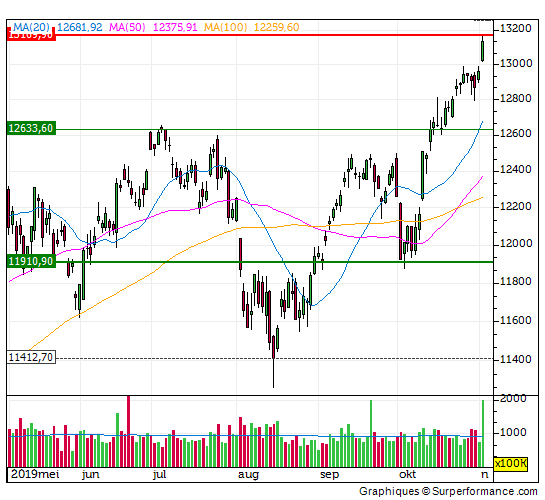
De AEX index is gisteren weer gestegen en daarmee in de grafiek weer boven de MA50 lijn gekomen. Een heel kleine verbetering in een op dit moment neutrale zone. Beleggers wegen de gevaren van Corona nog niet echt mee, terwijl dit virus toch echt al wel impact op de wereldeconomie heeft gekregen.

Is an Accommodative Fed Bullish for the Stock Market?
“In 2007-2008, the Fed cut rates 10 times, but the S&P 500 still declined 58%”
By Elliott Wave International
Many investors heed every utterance from the Federal Reserve, hoping they hear a clue about interest rates. They assume that a fall in interest rates means higher stock prices, while rising rates will push stocks lower.
First, Elliott Wave International’s research shows that the Fed follows the bond market. It doesn’t lead it.
Secondly, EWI’s research reveals that stock prices have risen during trends of lower and higher rates. Likewise, there have been periods of falling stock prices during trends of lower and higher rates too. In other words, there is no consistent correlation between the trends of stocks and interest rates.
As Elliott Wave International President Robert Prechter has noted:
It is nearly impossible to find a treatise on macroeconomics… that does not assert or assume that the Federal Reserve Board has learned to control the credit supply, interest rates, the rate of inflation and the economy. Many people believe that it also possesses immense power to manipulate the stock market.
The very idea that it can do these things is false.
Yet, the widespread belief that the Fed holds a lot of sway over the stock market persists.
On Dec. 27, for example, no less than The New York Times said:
Three Federal Reserve rate cuts and a rally in huge tech stocks like Apple have helped lift the S&P 500 by 29 percent so far in 2019.
Then, on Jan. 13, a major financial website said (CNBC):
The stock market has been riding high, helped in large part to two critical moves the Fed made in October.
One was a pledge to hold rates steady while inflation remains low, the other an intervention in the repo market.
Yet, here’s another perspective from our Jan. 17 U.S. Short Term Update:
The chart is reproduced from [the March 2019 Elliott Wave Financial Forecast] showing the lack of correlation between Fed behavior and the stock market. The Fed cut interest rates 13 times from 2000-2003, yet the S&P 500 still declined 51%. Again in 2007-2008, the Fed cut rates 10 times, but the S&P declined 58% from August 2007 to March 2009. Subsequent to that, 9 Fed rate increases starting in 2015 didn’t stop the stock market from rallying. Simply put: The Fed does not control the trend of the stock market.
So, the widespread belief that the Fed controls the stock market is a myth.
There are several other market myths that investors need to know about.
Get our insights in the free report: Market Myths Exposed.
Weet u wanneer iedereen positief is?
- Net voor de val van de beurs!
Het zou niet de eerste keer zijn dat de beurs volledig onderuit gaat net nadat iedereen heeft uitgesproken dat alles op rozen gaat verlopen. Het toppunt van optimisme is altijd net voor de val.
Het is ook niet zo gek, want als iedereen al positief is, wie moet er dan nog gaan kopen?
In die zin ben ik nu heel voorzichtig op de beurs. Het ziet er allemaal veel te mooi uit…
Is het dan nu al over?
Neen, dat hoeft niet. Eind 1997 gaf een beroemde analist aan dat hij het allemaal veel te hard vond gaan. De beurs topte volgens mij pas in maart 2000. Hij had gelijk qua overdreven optimisme, maar als de beurs eenmaal overdrijft, dan doet ze dat ook in het kwadraat.
In die zin moet je nu ook niet direct in paniek wegrennem omdat het zo goed gaat. De andere kant is meegaan in het blinde enthousiasme. Dat lijkt me ook niet erg verstandig.
Aanstaande zondagmiddag ben ik de laatste spreker op een drie daags vastgoed seminar. De 70 deelnemers aan dit evenement krijgen in drie goed gevulde dagen een enorme berg aan informatie en kennis over verschillende mogelijkheden in de vastgoed sector. Er zal onder meer iemand spreken met, zo ver ik weet, 2.100 woningen in zijn bezit. Daar steek ik schril tegen af met mijn huidige 22 woningen en één te verbouwen appartementencomplex.
Mijn speech zal zeker afwijkend van de rest zijn. Dat komt mede omdat ik nu eenmaal een route en eindpunt heb gekozen waar tot op heden weinig anderen hebben durven te gaan.
We zullen achteraf pas weten of dat briljant of vreselijk dom van mij was, maar vooralsnog heb ik geen spijt van mijn afwijkende pad.