


The polluting textile industry
In second place of the most polluting industries in the world is the textile industry.
After the oil and gas that have been in the top place for decades, but with the improvements and reductions that are going on there, the penny is changing.
water
Currently 25%, but within 8 years 40% of all water pollution is caused by the textile industry. On average, 100 liters of water are needed to dye 1 kilo of cotton, in the case of cotton / polyester this is double.
Pesticides
To grow a kilo of cotton, 2.5 kilos are used
Combustion
A company like H&M has to deal with 22% surpluses (unsold items) and opts for incineration to avoid a cheaper offer through EBay.
Export of our problems
In a country like Ghana, 14 million used textile products are dumped from the EU every week
The size of the textile industry
Looking only at Europe and only at the product T-shirts, 3.4 Billion T-shirts are sold annually in Europe.
Far East
Almost all T-shirts are produced in the Far East.
The most popular country is Bangladesh, because of the lowest price.
In addition, countries such as India, Vietnam, Cambodia and China are major production countries.
An industry that is completely manual and employs tens of millions of people.
Circularity B.V.
In Etten-Leur we start with robotized production of T-shirts.
It is expected that sometime in 2024 we will be able to achieve a production of 500,000 T-shirts per month step by step.
In contrast to the Far East, these are not stitched together by 600 people in the stitching department, but by robots where 1 supervisor is present per shift.
Scalability
An annual production of 6 million T-shirts is only 0.0017 share of what is sold annually in Europe alone.
Circularity platform
In October 2021, we reported for the first time in Warsaw in Poland that we are looking for cooperation with parties / countries that want to change / improve the textile industry in a 100% circular way.
See: https://www.youtube.com/watch?v=NMxp_DF9sFU
Roll-out model and potential
In order to achieve a 1% share within Europe, 57 copy-paste production companies would have to be set up in Europe. This indicates that sufficient growth opportunities can be created.
Influence of Brussels
Brussels, Frans Timmermans has identified textile change as one of his spearheads.
Brief overview of the upcoming actions from Brussels:
- From 1 January 2023, the UPV Act will be in force in the Netherlands.
This means that the supplier/importer of (work) clothing is obliged to take it back after using the clothing. The clothing must then be processed in a circular manner.
Companies can include the ecological savings in their annual report.
- By 2025, ALL textile items must consist of 50% recycled content.
- In 2027, there will be a special CO2 tax on imported items from the Far East
- By 2030, it will no longer be allowed to use recycled PET bottles for the production of clothing. (In China, new PET bottles are produced and the neighbor fiberizes them, so that there is recycled PET).
- By 2050, all textile products must be 100% circular.
Circularity can already do this.
Differences in terminology
Recycled clothing: clothing that is partly or entirely made from recycled cutting waste
Circular clothing: is made from used clothing or clothing surpluses, WITHOUT the addition of virgin materials (so WITHOUT new raw materials: cotton or polyester)
Recycle
There are two types of recycling:
- Chemical recycling: by adding kilos of chemicals, a separation takes place between polyester and cotton.
This process has 5 disadvantages:
- One is left with a large amount of chemicals (junk) that will have to be destroyed
- It is much more expensive
- The separated fibres must be repainted
- All kinds of permits will have to be met before a municipality gives approval
- Expensive machines
- Mechanical recycling: what Circularity does is fiberize (pull apart) cloth to form bales. These are converted into yarns in the spinning mill.
This process has 5 advantages:
- We do not have any residual waste left over
- It is much cheaper than chemical recycling
- Yarns do not need to be repainted
- It can be set up anywhere, without special permits
- Cheap machines
Knowledge of textile production
Han Hamers started in the textile industry in 1983.
In 1986 we started our own production of T-, polo, sweatshirts and jogging suits in Legnano, just outside Milan in Italy.
In 1989 joint venture set up in Poland, production of workwear, tracksuits.
In 1991 joint venture in Tirupur India for production of T-shirts and polo shirts.
In 2005 joint venture set up first ecological textile dyeing company Mahan Ltd. in India.
Set up his own company in 2012 with daughter Sally in Bangladesh.
Proof of concept
The development of the entire concept started in 2014 in Tirupur India.
First of all, cutting waste was converted into a new yarn. This process took 4 years before we had a yarn that was strong enough for the production of workwear T, polo and sweatshirts.
In 2018, all kinds of different textile waste streams were collected in Europe (work trousers, overalls, towels, sheets, T-, polo and sweatshirts). These were mutated in the Netherlands (chopped into small pieces) and shipped to India. New yarns were made, tested and approved by TUV.
Changes Far East
In 2018/2019, China decided to introduce a ban on used plastics from Europe.
This was followed shortly afterwards by a ban on the import of used textiles.
Because entire container ships full of used/worn textiles sailed to the Far East, they moored in other countries.
As a result, Bangladesh, Cambodia, Pakistan, Vietnam etc. etc. also closed their borders.
India
India was the only country to remain open, but a 22% import tax must be ticked off upon entry. Partly because of this, our development of products was able to continue and continues in India.
Range of products
The development from India therefore resulted in a 100% circularly built T-shirt after 4 years, in 2018.
By further adjusting the yarn, the same yarn can also be used for polo and sweatshirts.
From August 2022, we will be able to produce the following package of 100% circular products in India:
- T-, polo and sweatshirts
- Towels and tea towels
- Work trousers, overalls, tunic, dust jackets, aprons
- Tote bags and bags
The following products are in the final stages of development:
- Sheets and bed cover
- Sports shirts
Etten-Leur
Etten-Leur
In Etten-Leur we rent a location of 7,800 m2 including office space. A building large enough to enable the ambition of 500,000 T-shirts per month.
The run-up was delayed quite a bit due to corona.
The first down payments of machines took place in 2020, with the promises that the first machines would be delivered in January 2021.
The final delivery time was August 2021, after which we could start building machines. A process that requires a year and a half.
Activities in order of production
- Collect used textiles.
For this we charge an amount of € 1.50 per kilo
- Strip:
Removing contrast colors and logos
- Mutating and fiberizing:
This is 1 line, which mechanically pulls textiles apart and squeezes them into bales.
- Spin:
Making yarns.
- Knit:
On circular knitting machines, cloths are knitted for T-shirts (or polo and sweatshirts)
- Paint:
For fashion customers we offer the possibility to apply any desired fashion color on a waterless paint system.
- Cut:
The patterns are punched on a smart system to guarantee 0% deviation in the sizes
- Tampon pressure:
Because we do not use labels, an indication is made on the inside of the back of the back of the back of the size, composition and ecological savings.
- Robotic stitching line:
The parts of the T-shirt are stitched together
- Fold and stack line:
The T-shirts are automatically folded and stacked
- Packing line:
The stacks are placed in a box, sealed and provided with a sticker and barcode.
Staff
Our starting point for production in the Netherlands is to automate as much as possible, so that we need as few personnel in the production process.
Here is an overview needed for the production of 500,000 T-shirts per month:
Strip 5 (people with disabilities)
Mutate/fiberize 2
Spin 2
Knit 2
Paint 1
Cut 1
Tamponing 1
Choke 3
Pack 1
Prices Far East
Since we said goodbye to Bangladesh (the cheapest production country in the world), we have of course followed the price developments closely.
Currently, a large buyer of T-shirts pays a similar T-shirt in Bangladesh for € 1.65
Cotton prices
Due to a rising world population, the demand for cotton is increasing. In addition, the cultivation of cotton is declining, due to climate change. The result: an almost constant increase in cotton prices
And with that, production prices
Price structure of a T-shirt
The price of a T-shirt can be divided into 3 main groups with the following distribution:
60% raw materials (cotton and polyester)
20% Labour costs
20% Others
Price structure T-shirts Etten-Leur
If we use the same distribution, we come to the following conclusion:
Raw materials: is free, in fact for this we ask money of € 1.50 per kilo
Labour costs: determined 80%, but is limited by automation
Others: determined 20% for electricity, office staff
This brings us to a production price of < € 1.00 each
Structure of the textile industry
Individual
The textile industry is pre-eminently the industry where the motto applies: “every man for himself, God for us all”. This common thread runs through all parts and applies to every part, but also to every continent.
Far East
The Far East’s share is about 90%.
If we zoom in on how it is structured there, we see almost only companies that take care of 1 part of the total process
- Cotton cultivation
- Spin
- Knit
- Paint
- Cutting and confection
- Embroidery and printing
Because each company works separately, a profit margin of 10-20% is added per component. This runs the risk of jeopardising a total price, so child labour must be used in order to remain competitive. Working longer without continuing to pay in the cheapest accommodations.
Europe
Things are not much better in Europe.
- Importers
- Wholesalers
- Embroidery and printing
- Logistics companies
Importers:
Switch to the cheapest production country and continue to look for the cheapest manufacturer (i.e. with the worst facilities and with child labour)
Wholesalers
Have become more and more showrooms and only have customer-related stock.
Scale up their payment period to 60 days, while customers have to pay in cash or with 14 days.
In addition, people continue to look in the Far East for cheaper prices to buy larger orders directly in the Far East.
Cooperation
Working together is a dirty word, is approached suspiciously.
Agreements apply until a solution is found to import a product by other means or directly from the Far East.
Unique concept
The concept that Circularity has designed is completely contrarian:
- Bringing production of each part under 1 roof
- Producing cheaper than Bangladesh through robotisation
- They are 100% circular items, which only increases the difference with Bangladesh in favor of Circularity
- Delivery times are much shorter
- Per 200 pieces can be produced on special color (V.O. from 1,000 pieces)
- A return collection system is provided
- There is commitment from people with disabilities
- Return collection generates money
- The system supports is with 2 certificates
Sale
We don’t sell a product, we sell a concept.
Instead of entering into a discussion with a customer about the price of products, we deliver a total solution.
Example sales
The supermarket COOP has been taken over by Plus.
This means that COOP employees must be dressed with new clothing.
COOP has already collected 20,000 kilos of used workwear.
This would be burned, with the cost for COOP € 4,000
We have offered the following.
We receive the 20,000 kilos for € 1.50 per kilo is € 30,000
For this we make either:
- 180,000 Tea towels, which we supply for € 1.45 each (are now sold at Plus for € 2.95 each
Revenue model for Plus is 180,000 x € 1.50 profit is € 270,000 minus expenses
€ 30.000 = € 240.000
Circularity revenue model:
180.000 x € 0.50 per tea towel is € 90.000
- We make new workwear for Plus for which we use the old clothing from COOP.
We will talk about this further in October
Example chain store
Zeeman: have an LOI with Zeeman. Want circular products, want a “made in Holland”
product and do a total of 40 million T-shirts per year.
H&M: also an LOI. Want a circular product, but above all production in the EU, so that people can use they can reduce surpluses of 22%. H&M buys 40 million T-shirts a month.
Distribution of sales groups
The following distribution of target groups:
a. Chain store:
b. Industrial customers:
End users who need workwear
c. Hospitals / Healthcare:
These are government/semi-government institutions that are obliged to choose a sustainable/circular solution.
d. Dutch army and police.
e. Wholesalers:
f. Fashion Brands:
g. Industrial laundries
Example industrial customer
More than 2.5 years ago we started a pilot project with Kaufland. An article had been posted in the SudDeutsche Zeitung with the comment; “We no longer want to burn our used workwear, who knows, a suitable solution”. Within 1 week we were at the table and received 20,000 used polo shirts. Stripped and sent to India in mutated form.
Here we have developed yarn for Tote Bags, which we will now deliver to Kaufland, so that Kaufland has a revenue model instead of expenses with the sale of Tote bags in the stores.
In the meantime, Kaufland has conducted a study on the total amount of workwear that is bandaged annually. The result is 1.5 million kilos, or 6 million T-shirts, that could be produced.
Hospitals / care
Research done on hospital consumption.
A large hospital does 100,000 pieces of workwear per year (work trousers, polo shirts, tunic).
Flats: sheets, bed cover, towels runs through the industrial laundries
Before the start of September 1, I found a seller who had been active in the healthcare / hospitals sector for years.
Dutch Army and Police
Have a contract from both that we may receive the used clothing. Soon we will scale this up with tender tenders: T-, polo, sweatshirts, towels
Wholesalers
Come to Etten-Leur together with their end users (industry customers) to get acquainted with circular production.
Fashion Brands
Fashion brands that either want to become more sustainable, or want to buy closer to home, or aspire to a “made in Holland” product.
Industrial laundries
Because the developed products are industrially washable (drying at 60C and 180C), the two largest parties in Europe Elis and CWS have already visited and various tests of various products (T, polo, sweatshirts, towels, sheets and bed cover but also work trousers and tunics) are ongoing.
Scaling up / Growth strategy
Learning process
The last few years have been an impressive learning process.
We notice that when Brussels / Frans Timmermans focuses on circularity, this is a huge incentive for all named sales target groups.
In other words, the parties are forced to switch to circular processes,
In other words, our model has the wind in its sails.
Precursors situation
Circularity is a large number of years ahead of its competitors.
In the Far East, people are not interested in circularity: “my father did it this way, his father did it this way”.
In addition, all countries (except India) are closed to imports of used textiles. So one can recycle, but not offer a circular product.
In the Netherlands / Europe there is no longer any knowledge of how a product should be built.
Because Han Hamers has always been busy, as a producer, this knowledge is present.
- Set-up of production facilities
Netherlands
Our pilot factory where we copy-paste step by step and set up our India proof-of-concept with automation.
Germany
In Q3 2023, Circularity Germany was founded.
Are approaching various potential partners.
Kaufland (part of Schwarz Gruppe) is one of the candidates.
Soex, Germany’s largest textile collector
Poland
In 2024 we want to set up a production company in Poland.
Have found a party for this: LPP, which would like to come in steps to 400,000 T-shirts per month on condition that it will become a “Made in Poland” article.
Negotiations are currently underway with a European industrial laundry to tackle this together.
Ghana
We have been approached by representatives of Ghana to solve a huge ecological problem in Ghana. Every week, 14 million kilos of used EU textiles are dumped, burned and floated into the sea in Ghana. They want to use our system (our technique) to set up textile production there.
Production distribution
The moment production takes place in several places, one can strategically distribute products, using wage benefits / import taxes. At the moment, this amounts to the following distribution of activities:
India Nederland Poland Ghana Duitsland
T-shirts x x x x x
Pole x x
Sweatshirts x x
Towels x x
Theedoeken x x
Werkbroeken x x x
Tunics x x x
Shirts x
Tote Bags x x
Sheets x x
Import duties
From India, a percentage of 9.9% import duty is levied for the EU.
A 0% import duty applies from Ghana.
So some products can come cheaper from Ghana than from India.
More production locations
Setting up multiple production locations is possible, alone or together with another party.
If we do not have any cash in hand, our share will only be small, which will be reflected in the share ratio.
Growth model
Land
We can scale up from the production locations mentioned above.
However, compared to what is sold annually in Europe, this is only a fraction.
Chain store
H&M buys 1 million T-shirts every month at 40 locations in Bangladesh and production Ghana would be completely sold out on T-shirts alone.
Revenue model for delivery to a chain store is approximately 30-60% on the production price.
Wholesale workwear
Industry customers have long-term contracts with wholesalers (3 to 5 year contracts).
When approaching industrial customers ourselves, we are often told: “we still have an ongoing contract with x-groothandel”.
Double-earning model
Strategically, it would be best if there is sufficient financial support to acquire top-10 companies in certain countries in the field of workwear.
A wholesaler with industrial customer contracts has x number of customers who can guarantee us a guaranteed turnover.
This not only earns us the difference between production and sales price to a wholesaler, but also the difference between purchase price wholesale and sales price to industrial customer.
Analysis of a wholesaler and setting up synergy
In addition to sellers, every wholesaler often employs a number of people, who become redundant in the system through acquisitions or participation of 51% shares.
The so-called product developers and buyers who travel the world for cheaper products. It is the expensive people in a system that can go completely overboard if Circularity is the only party that produces and delivers the products.
The wholesaler will buy cheaper because the importer is eliminated
The wholesaler will buy cheaper because Circularity is the producer
Wholesale saves or travel and accommodation costs Far East
The wholesaler saves on product developers and buyers
Circularity
Earns more from a wholesaler than from a chain store
Scales up with its return logistics system of € 1.50 per kilo
In addition to the wholesaler, there is a group of buying customers (industry customers)
Circularity is assured of an extra turnover
Revenue model towards wholesale is between 50-400%
Revenue model wholesale towards industrial customer 50-200% (depending on order size)
Analysis of a fashion brand and setting up synergy
What kind of wholesale money, is different for Fashion Brands.
Smaller brands in the middle and higher segment no longer buy in the Far East, but in Turkey. Here one expects greater flexibility and oders can be less large.
The structure is different.
Fewer sellers and more product developers and buyers.
Every fashion brand has its own stature, its own DNA.
Above all, this must remain the case.
The improvement for fashion Brands is in
You can buy cheaper from Circularity than in Turkey
You can buy more flexibly from Circularity
One reduces unsold items
Travel costs become unnecessary
Buyers can leave the system
For Circularity, this means
Increased turnover
Increasing knowledge of fashion
Revenue model towards fashion brand is between 50-100%
Revenue model fashion brand towards consumer 200-800% (depending on brand)
Logistics
By linking activities for Circularity, there is an increase in scale.
This plays a role in reducing costs for logistics, but also in this area.
Description Conditions acquisition model; wholesale/fashion brands
We need to identify per country which wholesalers are interesting to take over.
The following conditions apply:
a. A top 10 player in a country
b. A net profit margin of 20%
c. One must have large industrial customers as customers
d. One must need our products in large quantities
e. Maybe define revenue amount
f. NL management runs the company
With this we are assured of production
This guarantees a profit model.
The shareholders are guaranteed a nice margin on their investment.
Savings:
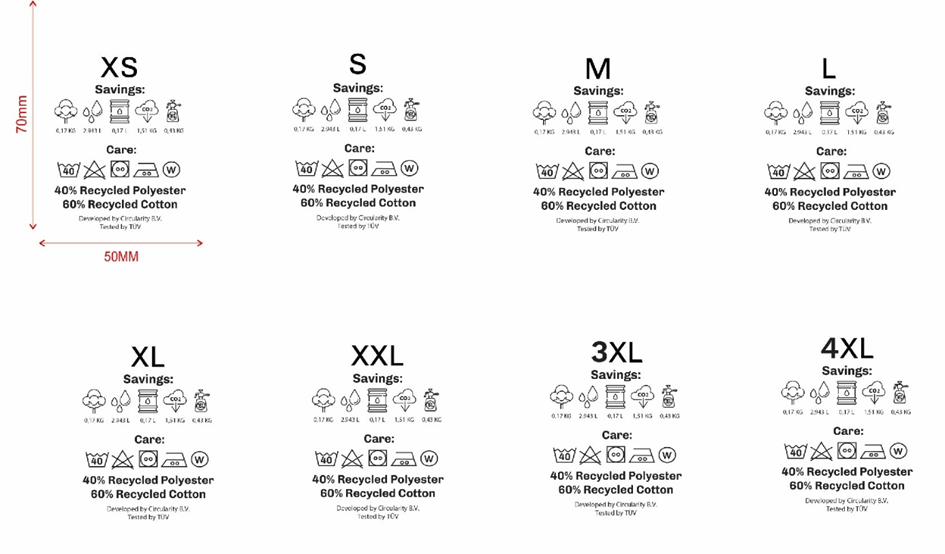
Per KG of cotton, raw materials and pesticides are needed:
- 17,500 litres of water
- 2.15 KG pesticides
- 0.85 litres of oil
- 6.55 KG C02 emissions
Per KG polyester:
- 100% oil product
Besparingspotentieel Circularity BV
The expected savings in CO2 emissions after achieving the results as intended in this project are shown schematically below, this concerns the cumulative achieved CO2 emission savings of Circularity. They shall keep as a reference the sales of the product as a total of piece(s):
| Year | Marketing Pieces | Saved raw material cotton (KG) | Saved raw material polyester(KG) | CO2 saved (KG)1 | |
| 2024 | 3.000.000 | 324.000 | 216.000 | 906.000 | |
| 2025 | 4.000.000 | 432.000 | 288.000 | 1.208.000 | |
| 2026 | 5.000.000 | 540.000 | 360.000 | 1.510.000 | |
| 2027 | 6.000.000 | 648.000 | 432.000 | 1.812.000 | |
| 2028 | 6.000.000 | 648.000 | 432.000 | 1.812.000 |
It should also be noted that the polyester that Circularity uses comes from the wiring harnesses from the windmill industry, which are recycled and reused into the polyester for the yarns. For the packaging of the clothing, Circularity ocean uses waste plastics which are recycled into the necessary packaging of the T-shirts. The latter is not included in the calculation.
Meer weten en ook eventueel interesse in investeren:
Jasper van den Brink
Brinkx B.V.
Torenallee 45
5617BA, Eindhoven
+31 (0)6 343 65 172