We zien de laatste weken een structurele daling in de AEX index. Iedere top is lager, maar ieder dal ook. De steun ligt rond de 500 punten. Er is overigens ook een zwakkere steun rond de 530 te vinden.

We zien de laatste weken een structurele daling in de AEX index. Iedere top is lager, maar ieder dal ook. De steun ligt rond de 500 punten. Er is overigens ook een zwakkere steun rond de 530 te vinden.

De trend is neutraal tot heel voorzichtig opwaarts gericht. De koers ligt aan de goede kant van de MA lijnen. Bij een doorbreking van het 13,75 niveau is een voorzichtige korte termijn long positie te overwegen.

Mijn laatste analyse was op 30 april van dit jaar. Toen was ik niet enthousiast over het aandeel. Achteraf bezien toen goed gezien, maar begin juni veranderde het beeld en toen hoorde u niets van mij.
Er is nu een sterke stijgende trend waarop u mogelijk nog even kunt meerijden. Toch zou ik de hand aan de pols houden, want er komen nog twee weerstanden aan. Er ligt in de grafiek een gap op 36 en een top die doorbroken moet worden op 38.

Gisteren wel een stijging voor de AEX, maar geen doorbreking.
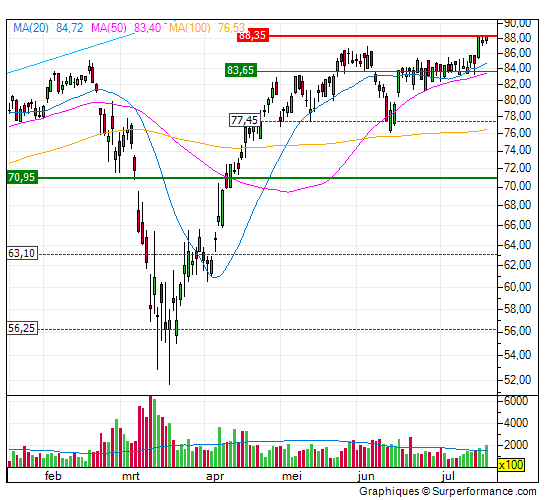
Een interessant moment… Als de koers vanochtend om 10:00 uur boven de slotkoers van vrijdag (88,35 euro) staat, dan is er wat mij betreft sprake van een koopsignaal. Stop loss daarna op 87.95 euro per aandeel leggen.


Het aandeel ING zit momenteel in een neutrale trend. De bovenkant is te vinden rond de 6,7 en de onderkant rond de 6 euro per aandeel. Ik zou hier geen positie innemen.

Grofweg is het zo dat de AEX moeite lijkt te hebben met de 580. Het is niet zo dat er een stevige weerstand ligt, maar al sinds begin juni zitten we vooral in een neutrale trend die pas doorbroken wordt bij een stand boven de 580.

In de grafiek van het aandeel Aalberts is overduidelijk dat er een weerstand ligt op 30,5. Al drie keer, misschien zelfs vier keer eerder is de koers op dat niveau gestuit en ging daarna weer omlaag.
Ik zou hier dus nooit onder dat 30,6 long gaan. Liefst zelfs nog een dag wachten na de uitbraak.
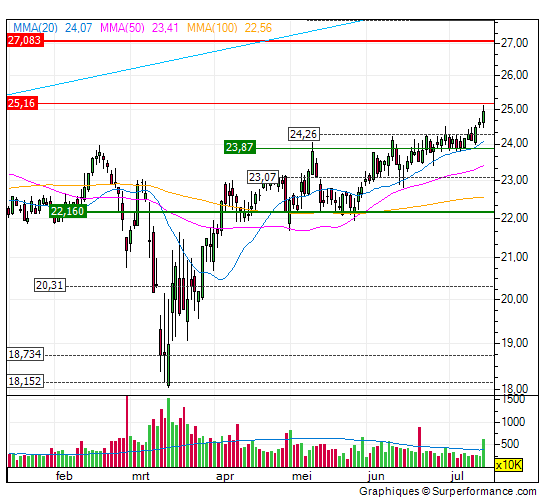
Het aandeel Ahold Delhaize is wat mij betreft technisch uitgebroken en koopwaardig. Laat de stop loss lekker meelopen en leg die 1,5 euro onder de hoogste slotkoers.

The stock market is a fractal — i.e., a self-repeating form at all degrees of trend. Meaning, without the time or price labels, you can’t tell if you’re looking at a 2-minute chart or at a monthly one.
What’s more, stock market trends unfold in repetitive and recognizable price patterns.
What’s more, these patterns — Elliott wave pattens — emerge regardless of the news.
Yes, there may be very brief reactions to news, but then the main trend continues. That’s because the larger stock market trends aren’t driven by the news, they are driven by market participants’ bias, bullish or bearish. What we call, market psychology.
That’s why you often see headlines with the word “despite” in them — like, “Stocks rally despite U.S. unemployment at the highest level since the Great Depression,” or “Stocks fall despite stronger-than-expected consumer confidence report.” That word, “despite,” tells you everything you need to know.
Review Part I and Figures 1 through 5 in Chapter 12 of Robert Prechter’s 2017 book, The Socionomic Theory of Finance, and you’ll see evidence that the market is not priced according to external conditions.
And, here’s what the book says about those brief reactions:
Evidence for even temporary emotional reactions in markets is surprisingly suspect. All market observers have seen futures prices gyrate more intensely for a few seconds or minutes before and/or after an announcement perceived as major news. However, ensuing market movement may be totally opposite to the tenor of such news, even when it is a total surprise.
This quote came to mind when, on June 29, this sobering news appeared on a major financial website (CNBC):
Nearly half the U.S. population is without a job, showing how far the labor recovery has to go
The employment-population ratio — the number of employed people as a percentage of the U.S. adult population — plunged to 52.8% in May, meaning 47.2% of Americans are jobless.
Interestingly, on that very day, the DJIA closed up 580 points.
Plus, as you know, the stock market has bounced back substantially since the March lows, despite a historic slew of negative news.
Indeed, the June Elliott Wave Theorist, a monthly publication which has offered subscribers analysis of financial markets and cultural trends since 1979, showed this chart and said:

The first reports of economic contraction came out in March and continued through May. … Stock prices not only rose for seven weeks but also jumped higher on nearly every report of a rise in unemployment claims. A particularly big up day occurred when statistics suggested an increase in employment, but analysts quickly recognized that the numbers were untrustworthy due to restrictions in data collection deriving from the pandemic. No matter; stocks went up the next day, too.
In fact, you can also see that the stock market rose more than it fell when Covid-19 dominated the headlines! It also rose on the day of the first protests — and continued to climb for two weeks, despite the vandalism, looting and clashes between protestors and police not seen in decades.
The real driver of the stock market’s trend is investor psychology, which Elliott waves reflect.
As the book, Elliott Wave Principle: Key to Market Behavior, notes:
The Wave Principle is governed by man’s social nature, and since he has such a nature, its expression generates forms. As the forms are repetitive, they have predictive value.
Sometimes the market appears to reflect outside conditions and events, but at other times it is entirely detached from what most people assume are causal conditions. The reason is that the market has a law of its own.
Learn about this “law” of the market.
You can do so by reading the online version of Elliott Wave Principle: Key to Market Behavior, which is available to you free when you join Club EWI. Membership is also free.
Club EWI is the world’s largest Elliott wave educational community and members get free access to a wealth of resources on investing and trading.
Click on this link to get started: Elliott Wave Principle: Key to Market Behavior — read it for free.
This article was syndicated by Elliott Wave International and was originally published under the headline Stock Market: “Relevant Waves Vs. Irrelevant News”. EWI is the world’s largest market forecasting firm. Its staff of full-time analysts led by Chartered Market Technician Robert Prechter provides 24-hour-a-day market analysis to institutional and private investors around the world.